
Electrician Associate's Degree: 2-Year Clover Park Technical College Guide
An electrician associate's degree, usually 2 years in-person at Clover Park Technical College, prepares you for a stable, well-paid skilled trade. Here is what to expect.

By Lucas Scott
An electrician associate's degree, usually 2 years in-person at Clover Park Technical College, stands out as one of the most direct routes into a skilled trade that powers every home, hospital, data center, and factory in the country. If you are weighing a hands-on technical education against a four-year bachelor's program, this pathway deserves a serious look. Clover Park Technical College, located in Lakewood, Washington, has built a reputation for training electricians through a structured, cohort-based curriculum that blends classroom theory with extensive lab time. The program is delivered in person, which matters more than many prospective students realize: electrical work is physical, code-driven, and safety-critical, and employers consistently favor graduates who have logged real hours bending conduit, wiring motors, and troubleshooting live systems under instructor supervision.
This guide walks through what the degree involves, how long it takes, what it costs, what careers it opens, and how it compares with apprenticeship-only routes. It also explains how to evaluate whether an in-person trade program or an online degree pathway fits your life stage, because the right answer depends heavily on your schedule, your budget, and your long-term goals. Whether you are a recent high school graduate, a military veteran, or a career changer tired of desk work, the details below will help you decide with clear eyes.
What the Electrician Associate's Degree at Clover Park Technical College Covers
Clover Park Technical College offers an Associate of Applied Science (AAS) degree in Electrical Systems, and the program is typically completed in about two years of full-time, in-person study. The curriculum is not a generic academic degree with a few trade electives tacked on. It is built from the ground up around the electrical trade: direct current and alternating current theory, residential and commercial wiring, industrial motor controls, programmable logic controllers, the National Electrical Code, and hands-on installation practice in campus labs.
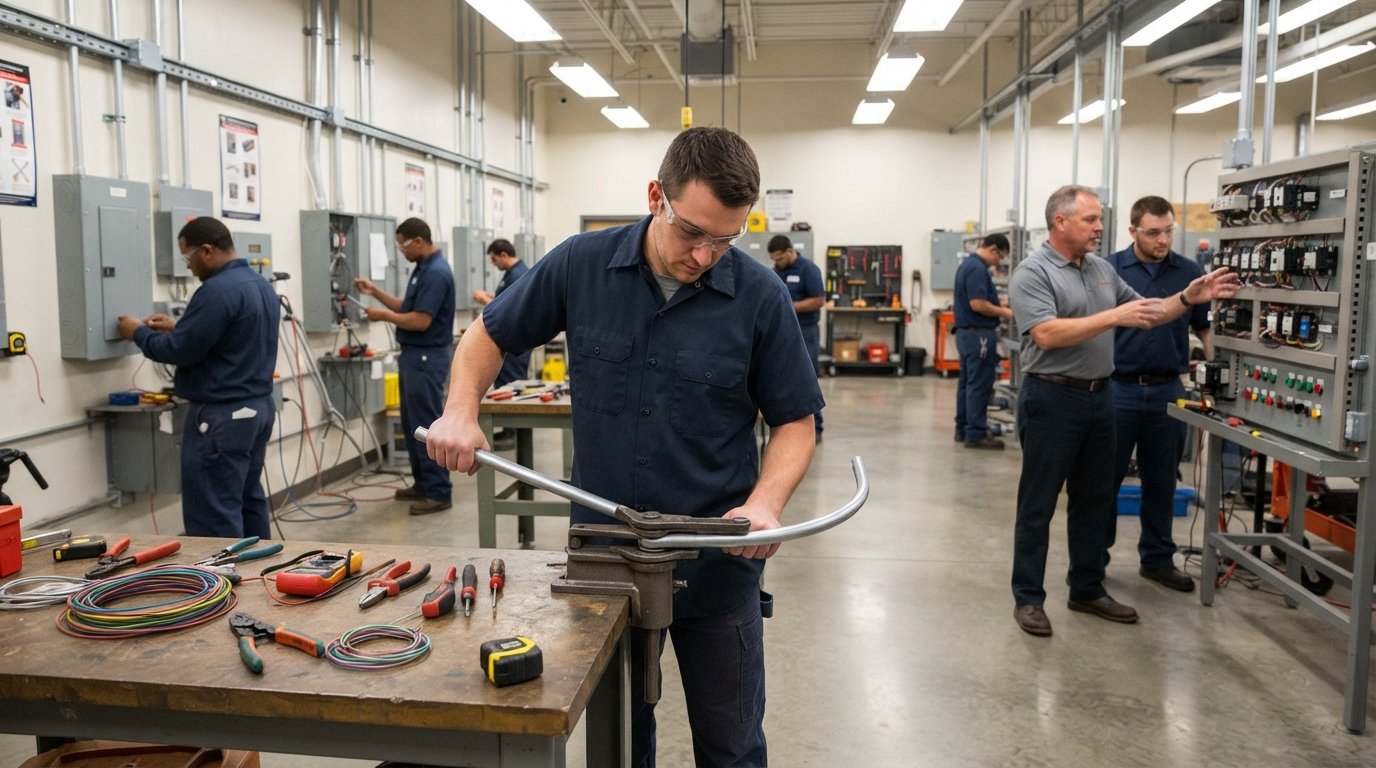
Students spend significant time in laboratory settings that simulate real job sites. That means pulling wire through framed walls, terminating panels, interpreting blueprints, and learning how to work safely around energized equipment. Instructors are generally journeyman-level electricians or engineers with field experience, which gives students access to practical troubleshooting wisdom that textbooks cannot fully capture. Because the program is in person, students also build the habits employers care about: showing up on time, working in teams, and communicating clearly about safety hazards.
The degree structure usually includes general education requirements alongside technical coursework. Expect courses in applied mathematics, communications, and possibly physics or technical writing. These are not filler. Electrical work increasingly demands the ability to read specifications, document installations, and coordinate with engineers and inspectors, and strong communication skills separate electricians who stay in the field from those who move into supervision, estimating, and project management.
Typical Coursework and Lab Focus
The technical core of the program generally covers a sequence that builds from fundamentals to advanced systems. A representative progression looks like this:
- Electrical theory and safety fundamentals, including Ohm's law, circuit analysis, and lockout/tagout procedures
- Residential wiring, including service entrances, branch circuits, and code-compliant installation practices
- Commercial and industrial systems, including three-phase power, transformers, and motor controls
- Programmable logic controllers and automation basics for modern manufacturing environments
- National Electrical Code study and exam preparation aligned with Washington State licensing requirements
Each of these areas is reinforced in the lab, where students physically build and test circuits. This hands-on repetition is the reason the in-person format matters. You cannot learn to terminate a 480-volt motor starter by watching a video; you learn it by doing it repeatedly under supervision until it becomes second nature. That practical confidence is exactly what apprenticeship coordinators and hiring managers look for when they interview graduates.
Admissions, Cost, and What to Expect as a Student
Admission to the program is generally open to students with a high school diploma or equivalent, though placement testing in math and reading may determine which foundational courses you start with. Because the program is cohort-based, students typically begin in fall or another designated entry term, and seats can fill quickly. Prospective students should apply early, complete financial aid paperwork, and attend an information session if one is available.
Cost is a major consideration for any degree, and trade programs are no exception. Tuition for Washington community and technical colleges is generally far lower than four-year university tuition, and the two-year timeline means you enter the workforce and start earning sooner. Financial aid, including federal grants, work-study, and scholarships, can offset much of the cost for qualifying students. Veterans benefits and workforce retraining grants are also common funding sources for students in this program.
Beyond tuition, budget for tools, personal protective equipment, textbooks, and possibly a laptop. Many programs provide access to lab equipment, but students are often expected to build a basic personal tool kit by graduation. It is worth asking the department for a current supply list before you enroll so there are no surprises. If you are also comparing this path with fully online options, a resource like this guide on choosing online college degree programs can clarify how online formats differ from hands-on trade training.
Time Commitment and Scheduling Realities
Full-time students should expect to treat this program like a job. Classes and labs often run during weekdays, and homework, code study, and project work fill evenings. Working students sometimes manage part-time jobs, but the in-person lab schedule limits flexibility compared with online programs. If you need to keep a full-time job while studying, discuss options with an advisor before committing; some students spread the program over three years to balance work and school.
Support services matter here. Tutoring, advising, and career services at Clover Park Technical College help students stay on track, and the college's relationships with regional employers give graduates a leg up when job hunting. Many students receive job leads before graduation through instructor networks and campus recruiting events.
Career Outcomes and Licensing After Graduation
Graduating with an associate's degree in electrical systems does not automatically make you a licensed journeyman electrician. Washington State, like most states, requires a combination of supervised field hours and examination to earn journeyman status. However, the degree accelerates that process significantly. Many graduates enter the workforce as electrical trainees or apprentices and receive credit toward their required hours because of their formal training. In some cases, employers start degree holders at higher wages than entry-level workers without formal education.
Career paths for graduates extend well beyond residential wiring. Electricians work in commercial construction, industrial maintenance, renewable energy installation (including solar and wind), data center operations, and building automation. With experience, electricians can move into estimating, project supervision, electrical engineering technology, inspection, or owning their own contracting business. Median wages for electricians nationally sit comfortably above the median for all occupations, and overtime opportunities are common in construction and industrial settings.
For students who want to keep climbing the educational ladder later, an associate's degree also preserves options that a pure apprenticeship might not. Credits may transfer into bachelor's programs in electrical engineering technology, construction management, or applied science. That flexibility is worth considering if you think you might eventually want a supervisory or engineering-adjacent role. For broader context on how degree levels affect earnings and career mobility, resources such as CollegeDegrees.School offer useful comparisons across fields.
Comparing the Degree Route With Apprenticeship-Only Training
One of the most common questions prospective electricians ask is whether they should pursue a degree or go straight into an apprenticeship. Both routes lead to journeyman licensing, but they differ in structure and timing:
- Apprenticeships pay you from day one while you learn on the job, but entry can be competitive and classroom instruction is often limited to nights.
- The associate's degree front-loads technical and code knowledge in a structured campus environment, which can shorten the learning curve once you are hired.
- Degree holders often qualify for higher starting pay and faster promotion into lead or supervisory roles.
- Apprenticeship-only workers may accumulate field hours sooner but sometimes lack the broader systems knowledge that industrial and automation employers want.
Neither route is universally better. If you need income immediately and can secure a competitive apprenticeship, that path works well. If you want a broader technical foundation, stronger resume credentials, and the option to pursue further education later, the Clover Park Technical College associate's degree is a strong choice. Some students even combine both: complete the degree, then enter an apprenticeship with advanced standing.
Is the Electrician Associate's Degree Worth It in 2026?
Demand for skilled electricians remains strong. Retiring workers, grid modernization, electric vehicle infrastructure, and data center construction all point to sustained hiring. An associate's degree from a hands-on program like Clover Park Technical College positions graduates to enter that market with credible training and a credential employers recognize. The two-year, in-person format is a feature, not a bug: it produces graduates who can safely perform work that online-only programs cannot adequately simulate.
Before enrolling, visit the campus, talk to instructors, and ask about job placement rates and employer partnerships. Compare total costs, including tools and living expenses, against expected starting wages in your area. If the numbers work and you are ready for a physically active career with real upward mobility, this pathway can pay off quickly. The electrician associate's degree, usually 2 years in-person at Clover Park Technical College, remains one of the more practical investments a student can make in a stable, well-compensated trade.